
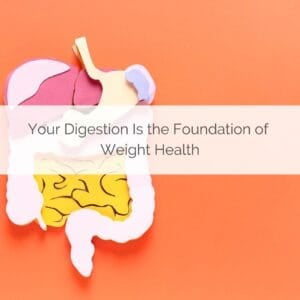
Your Digestion Does More Than You Think
A woman once called into a radio show because she was frustrated.
She had tried everything she could think of to lose weight. Different eating approaches. Different programs. Different supplements.
And yet she wasn’t getting the results she expected.
As we talked, I asked her about her digestion.
“Oh, that’s fine,” she said.
Then she explained that carbohydrates made her feel terrible.
I remember thinking: that’s not fine digestion.
One of the biggest misconceptions I see is that digestion and weight health are often talked about as separate conversations. They’re not. Digestion dictates weight health far more often than people realize.
Most of us start with calories, macros, meal timing, protein targets, supplements, exercise programs, or the latest nutrition trend.
Meanwhile, the system responsible for turning food into usable nutrients and helping regulate fat loss, muscle and bone building, energy, metabolism, appetite, and cravings is struggling.
That’s like trying to improve a factory’s output while ignoring whether the machinery is actually working.
If your body can’t properly break down food, absorb nutrients, move things through efficiently, and eliminate what it doesn’t need, it becomes much harder to support energy, metabolism, cravings, appetite regulation, body composition, and long-term health.
If you’re reading this, there’s a good chance you’ve already noticed digestive clues.
Maybe you’re bloated after meals. Maybe your digestion feels slow, inconsistent, or uncomfortable. Maybe certain foods don’t seem to work for you the way they used to. Maybe you need coffee to have a bowel movement. Maybe your energy crashes after eating or your cravings seem to have a mind of their own.
Most women don’t need me to tell them these things aren’t ideal.
What often surprises them is learning that these aren’t just digestive complaints. They’re clues about why their weight-health goals may feel harder to achieve than they should.
Because digestion isn’t just about food.
It’s how your body decides what to use, what to store, and what to eliminate.
And when digestion isn’t working well, many of the strategies you’re using to support weight health may never get the chance to work the way they’re designed to.
Then she explained that carbohydrates made her feel terrible.
I remember thinking: that’s not fine digestion.
One of the biggest misconceptions I see is that digestion and weight health are often talked about as separate conversations. They’re not. Digestion dictates weight health far more often than people realize.
Most of us start with calories, macros, meal timing, protein targets, supplements, exercise programs, or the latest nutrition trend.
Meanwhile, the system responsible for turning food into usable nutrients and helping regulate fat loss, muscle and bone building, energy, metabolism, appetite, and cravings is struggling.
That’s like trying to improve a factory’s output while ignoring whether the machinery is actually working.
If your body can’t properly break down food, absorb nutrients, move things through efficiently, and eliminate what it doesn’t need, it becomes much harder to support energy, metabolism, cravings, appetite regulation, body composition, and long-term health.
If you’re reading this, there’s a good chance you’ve already noticed digestive clues.
Maybe you’re bloated after meals. Maybe your digestion feels slow, inconsistent, or uncomfortable. Maybe certain foods don’t seem to work for you the way they used to. Maybe you need coffee to have a bowel movement. Maybe your energy crashes after eating or your cravings seem to have a mind of their own.
Most women don’t need me to tell them these things aren’t ideal.
What often surprises them is learning that these aren’t just digestive complaints. They’re clues about why their weight-health goals may feel harder to achieve than they should.
Because digestion isn’t just about food.
It’s how your body decides what to use, what to store, and what to eliminate.
And when digestion isn’t working well, many of the strategies you’re using to support weight health may never get the chance to work the way they’re designed to.
How Digestion Influences Weight Health, Energy, and Cravings
If you’re struggling with cravings, appetite, energy, body composition, or stubborn weight and haven’t focused on digestive assessment and optimization, you’ve probably missed one of the lowest-hanging fruits available.
Maybe you’ve tried to support your digestion and still aren’t getting the results you want.
Or maybe you’re not sure whether digestion is part of the problem at all.
I’ve personally been all three. So have my patients.
Because once you understand how digestion influences weight health, so many things that seemed random start to make sense.
Fat accumulates, cravings intensify, and appetite can feel impossible to satisfy when the body doesn’t get what it needs or can’t properly use what it’s getting.
This often shows up in ways that don’t seem connected at first.
You might feel hungry even though you’ve eaten what should have been enough food. Your energy may feel like a flame in a windy room, struggling to stay lit despite food and caffeine. Cravings can show up intensely at the sight, smell, or even mention of food. Or for no obvious reason at all.
Weight may not respond the way you expect. You may lose weight on the scale but feel softer, less energetic, or notice your clothes fitting differently. Or you may gain weight despite eating “clean” and exercising consistently.
Even your skin may be trying to tell you something.
The body is always communicating.
The question is whether we know how to listen.
This is one reason I’ve never liked the saying, “You are what you eat.”
You’re not what you eat.
You’re what your body can digest, absorb, transport, and use.
A food doesn’t become healthy because someone put it on a list. It becomes useful when your body can turn it into something that supports your health.
This is why digestive assessment comes first. If the first domino never falls, it becomes much harder for everything downstream to work the way it’s supposed to.
Not because digestion is the only thing that matters, but because it influences almost everything that comes after it.
And once we understand how digestion is functioning, we can start looking at what your body has been trying to tell you all along.
“I can’t say enough about how Ashley has changed my life. I had been having serious gut health issues for over a year. If you get the chance to work with Ashley, you should take it.” — Lisa A. Fitzmaurice
The 4 Key Functions of Digestion
| Digestive function | What it does | Key components involved | Clues it may need support |
| Break down | Converts food into a form your body can use | Chewing, stomach acid, digestive enzymes, bile, pancreatic secretions | Feeling overly full after meals, gas, bloating, food “sitting like a rock,” seeing undigested food |
| Absorb and use | Moves nutrients from the digestive tract into circulation so the body can put them to work. | Small intestine, gut lining, microbiome, transport proteins, nutrient cofactors | Fatigue, cravings, poor recovery, nutrient insufficiencies, feeling hungry despite eating enough |
| Move through | Keeps food and waste moving at the right pace. | Motility, nervous system signaling, hydration, fiber, muscle contractions | Constipation, diarrhea, irregular bowel habits, urgency, feeling backed up or out of sync |
| Eliminate | Removes waste and what the body no longer needs. | Colon, liver, bile flow, hydration, stool formation, microbiome | Incomplete elimination, strong odors, hard-to-pass stool, loose stool, skin changes, recurring digestive symptoms |
Digestive Symptoms: What Your Gut Is Trying to Tell You
Digestive function isn’t simply “good” or “bad.”
Most of us move along a spectrum, and the clues your body is sending can help reveal where support may be needed.
So how do you know whether your digestion needs support?
Your body tells you.
Your body sends very specific signals when digestion needs attention. Most people just haven’t been taught how to connect those signals to what’s actually happening.
Take a moment and think about which of these applies to you today, or most days over the past week.
What Your Digestive Signals Actually Mean
Review the following for how many you experience:
- Gas, bloating, burping, or reflux
- Constipation, difficulty moving bowels, hemorrhoids, or poop tha tlooks like pellets or is very hard
- You rely on a “helper” to poop — smoking, caffeine, supplements, herbs, or herbal tea
- Loose stools, diarrhea, or uncontrolled bowel movements
- Food allergies, intolerances, or foods you avoid because they challenge your digestion
- Acne, skin irritation, rosacea, or hives
- Unusual body or mouth odor
- You take supplements specifically to address digestive concerns
- You use prescription or OTC medications to manage your digestion
- Current diagnosis of a digestive or autoimmune disease, condition, or syndrome
- Have taken antibiotics in the last 8 years — oral, IV, or topical
- Struggle with belly fat — gaining it or an inability to lose it despite effort
- Battle persistent sweet cravings
If you recognize yourself in any of those symptoms, the next question becomes: what are they actually telling you?
When we step back and assess digestion more closely, patterns start to emerge.
At the high end, digestion is optimal. Your system has what it needs to do its job efficiently, including the ability to repair and maintain itself.

When digestion is not optimal, it typically falls along a spectrum:
- Dysfunctional — There’s a breakdown in how digestion is working. This can affect how food is processed, how nutrients are used, and how clearly your body communicates.
- Delayed — Things are happening, but not at the right pace. Digestion may feel slow, inconsistent, or out of sync.
- Suppressed — Your body has the ability to function well, but something is interfering. This could be stress, medications, past health history, or other external factors.
These aren’t labels. They’re patterns that help you understand what your body needs next.
Your digestion is not “good” or “bad.” It’s a pattern
Why Digestive Health Assessment Matters for Weight Health
In case you aren’t fully convinced yet, let me hit this home.
Your digestive tract isn’t just where food gets processed.
It’s where many of your weight-health hormones live.
It’s where they receive information about what’s happening in your body and where many of the signals that influence weight health are sent from.
Hormones involved in appetite, satiety, blood sugar regulation, inflammation, hydration, bone health, and fat metabolism are all connected to what’s happening in your digestive system.
Which means if digestion isn’t functioning well, those signals may not be functioning optimally either.
This is usually the moment where people pause and go:
“Wait… so you’re telling me my digestion affects all of that?”
Yep.
And once you see it, it’s hard to unsee it.
Because suddenly digestion isn’t just about bloating, constipation, or whether your stomach feels okay after a meal.
It’s about whether your body has the information and resources it needs to regulate hunger, manage energy, support metabolism, maintain muscle and bone, balance blood sugar, and do all the other things we often blame on willpower.
It’s an ah-ha moment that many practitioners, health systems, and policymakers still haven’t fully embraced.
So if this feels like a big realization, you’re not alone.
This is usually the moment where people start connecting their digestive symptoms to their weight-health goals.
Now we have something to work with.
And that’s exactly why digestive assessment matters.
Your Better Next Step: Start With Your Foundation
If your goal is to feel better, have more energy, and see real results from the effort you’re putting into your nutrition, your digestion matters.
A personalized plan can help you:
- Identify what your body is able to break down, absorb, and actually use
- Improve digestion and nutrient availability so your body gets more from what you’re already doing
- Support energy, metabolism, and weight health through better digestive function
- Address hidden factors that may be interfering with how your body is running
If you’d like to go deeper, there are three ways to get started. You can work through the digestive assessment and experiments in Your Best Shot, join the Better Nutrition Program community for additional resources and support, or work directly with me or my team for a personalized assessment and plan.
The goal isn’t perfect digestion. It’s better digestion. And when digestion improves, everything built on top of it becomes easier.
Book a free 15-minute consult, and let’s explore what your digestion is trying to tell you.
About the Author
Ashley Koff, RD, is a registered dietitian with 25 years of clinical experience and one of the country’s leading weight health experts. She is the founder of The Better Nutrition Program and the bestselling author of Your Best Shot. Her work focuses on personalized nutrition, gut microbiome optimization, GLP-1 wellness, and helping individuals achieve lasting weight health through approaches tailored to how their specific body functions.
FAQ
Question: If my digestion is bad and I am battling with my weight, does that mean I should take a GLP-1 medication?
Maybe. But the more important question isn’t whether GLP-1 medications work. It’s why your system needs support in the first place.
For some people, a GLP-1 medication can be a valuable tool. For others, digestive function, nutrient status, hydration, sleep, stress, muscle mass, or other factors may need attention first.
This is one reason I encourage assessment before assumptions. Understanding how your body is functioning can help determine whether a GLP-1 is the right tool, a tool to consider later, or simply one piece of a larger plan.
That’s a question best answered through a personalized evaluation rather than a one-size-fits-all recommendation.



If you are on a GLP1 and have digestive issues (some were present prior to ever taking the shot) what supplements can help move things in the right direction? Constipation, reflux, some heartburn, bloating. Been diagnosed with SIBO and dysbiosis. I am just asking in a general sense based on this info- what would be recommended. I understand some work for some and not for others. I do not have a gallbladder. It was removed 2 years ago.
I actually lost weight slowly on the shot, then started gaining weight back while still on the shot (lost 95 lbs in 2.5 years and gained 30 back in 1 year). I have been on the shots since they first came out (about 4 years now). I do get inbody scans and I am not losing muscle. I have had a dexa scan and my bone mass is great (osteoporosis runs in my family). I am on HRT – biote and compounded progesterone. I have Hashimoto’s and hypothyroid. I was borderline diabetic with a high A1C which is now normal due to the shot. I have high cholesterol (just one area is high) and am on a med for that (which I honestly believe I do not need, and something else is causing that number to be high). I was on high blood pressure meds, but no longer take those and my BP is now on the low side. I am now experiencing trouble staying asleep and was not having this issue after starting biote. I had a partial hysterectomy at 40 and am currently 56. I am also having very dry eyes and trouble seeing because of it. Already had cataract surgery last summer. I do have food allergies and other allergies and occasionally break out in hives for no apparent reason.
My DR has me taking a boatload of supplements and I don’t think I need most of them and it is very costly (like 25 supplements and meds). I want off of most of them and only take the necessity ones that actually support my body.
I am so glad you found us and so sorry for the delay in reply. I wouldn’t want to respond here so publicly but you are absolutely right to question the role of each supplement and look at how you can optimize your digestion along with your results. We have two options that will make it easy for us to connect – our first session is free so I would love you to book it here https://meetings.hubspot.com/team-bnp/15-minute-chat? so we can determine the better way to support you and the second is via our free community which you can access here https://thebetternutritionprogram.com/join-our-newsletter/