For years, people brought their nutrition questions to Google. Today, they bring them to AI.
“Build me a meal plan.”
“What should I eat to lose weight?”
“I’m 50, mostly plant-based, training for a race, and dealing with digestive issues. What should I do?”
Within seconds, an answer appears, and honestly, that’s pretty remarkable.
For the first time, people can ask questions in a conversational way and receive responses that feel personalized. Instead of searching through ten articles and three conflicting social media posts, they can simply describe their situation and get a plan.
At least that’s what it feels like.
But where is that advice actually coming from? And how personalized is it, really?
These are some of the most important questions we can ask as AI becomes part of how people make health decisions and providers use these tools to help with patient care.
Because while artificial intelligence can be incredibly useful, I’ve found that the most effective nutrition plans still rely on something else entirely.
Something I call Ashley intelligence.
Artificial Intelligence vs. Ashley Intelligence
A year or so ago, I learned that people were adding to their query “tell me what Ashley Koff RD would recommend” and Claude, Chat and Gemini do me dirty, impersonating me based on what they could find I’ve said publicly and adding their spin.
That’s when I realized you needed to hear this. There’s a big difference between the two AI’s out there.
Can AI can create a personalized nutrition plan?
My answer is yes… but only one AI creates the plan that’s better for your body, today.
AI Type 1, artificial intelligence, will give you some insights, it may even get curious, but it won’t be able to decode your body’s full set of signals and that tells us how it’s responding to your current choices. What’s better and what needs optimization.
AI Type 2 can do that. I call it Ashley Intelligence. Ashley Intelligence is the part that gets curious specifically about you and your body; she uses 25 years of patient care and practitioner experience to help you developed you plan. She doesn’t tell you what to do, she suggests experiments that will reveal how your body responds to a new choice.
It’s a different A, and it’s the biggest differentiator. It’s the pattern recognition that comes from working with real people and real bodies over time. It’s knowing that two people can have the same symptoms and need completely different solutions. It’s recognizing when digestion is the issue, when hydration is the issue, when stress is driving the problem, and when what looks like a food issue may actually be something else entirely.
Most general AI tools are trained on the same broad nutrition information, including public health recommendations, dietary guidelines, published content, and patterns from large amounts of publicly available information.
That’s the same data and recommendations that have led to staggering amounts of suboptimal health: fewer than 1 in 10 U.S. adults meeting optimal cardiometabolic health markers, about 7 in 10 adults classified as having overweight or obesity, and nearly half of Americans consuming less magnesium than recommended. And even those magnesium recommendations are based on Dietary Reference Intakes first published in 1997.
If you’ve ever read five different nutrition articles and found yourself more confused afterward than before, you’ve experienced what I call INFObesity.
Too much information, and even if any or a lot of it is good quality, the sheer quantity of consumption is overwhelming your mind and body. too many opinions, and too little clarity about what actually applies to your body.
AI Type 1 can accelerate that problem because it delivers answers so quickly and confidently that we forget to ask whether the answer is actually relevant and look into where the answers are coming from.
Recently I chatted with an AI about what to do for someone regaining their weight after stopping a GLP1 — it shot out an alarming statistic of failures via fat regain and suggested they go back on, citing the medication as a lifelong treatment. Yes, it could be a lifelong tool for some, but it isn’t accurate for all. Nor is the weigh regain data applicable every patient.
AI Type 1, non-Ashley intelligence wasn’t able to find the categories of why a person stopped that I’ve created and use in practice as well as train practitioners on – the “why” would be the most or at least a key factor in their outcome: were they at their goal body fat having maintained muscle and bone; coming off because they can’t tolerate side effects; coming off because of a health or life issue – pregnancy, cancer treatment, increased training for a sports event; coming off because they can’t afford or have access to their medication any longer. All of these will impact a person being in the stat or not, and dictate their plan components for post medication care.
That’s where AI Type 2 excels. Ashley Intelligence doesn’t collect information from available research alone or accept that research as applicable for every patient and thus the source of a “right” answer. They assess the person sitting in front of them, ask better questions, and look for the patterns that matter. They use evidence yes, but only as part of the recipe.
In my view, the most useful AI doesn’t replace Ashley Intelligence. It extends it. Type 1 plus Type 2 is delivers something better for you (and me).
How Do Different AI Tools Answer the Same Nutrition Question?
One of the easiest ways to understand the strengths and limitations of AI nutrition advice is to ask multiple tools the exact same question.
I recently asked ChatGPT, Claude, and Gemini the same questions.
How much fiber do I need, and how can I get that amount in?
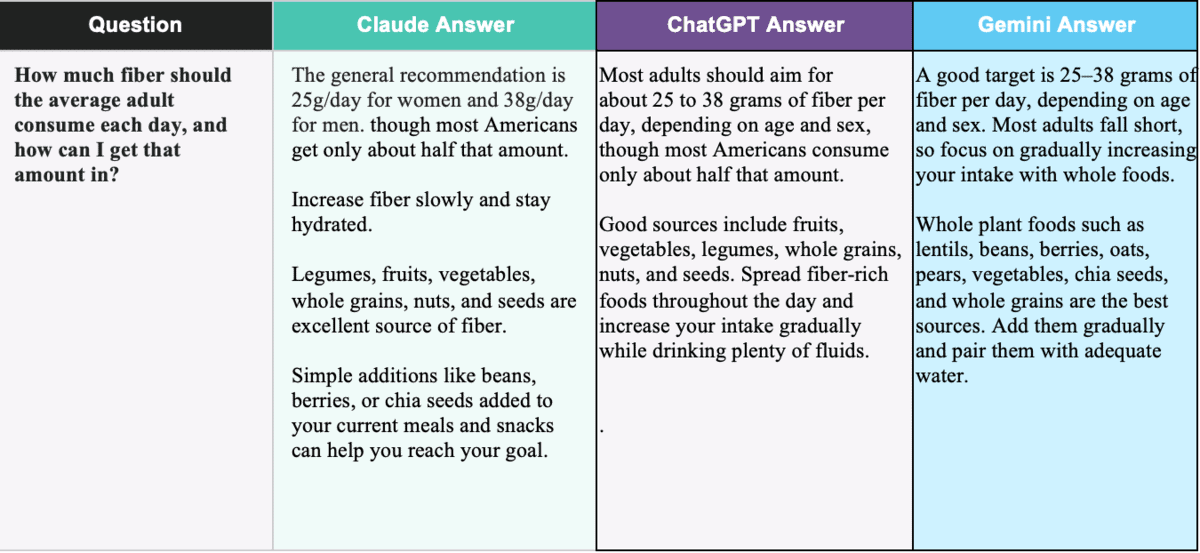
Then I compared those to the answer from the only source of AI Type 2 content The Weight-Health Nutritionist via ONIX a tool I’ve trained on my 20+ years of clinical experience personalizing nutrition advice based on the individual.
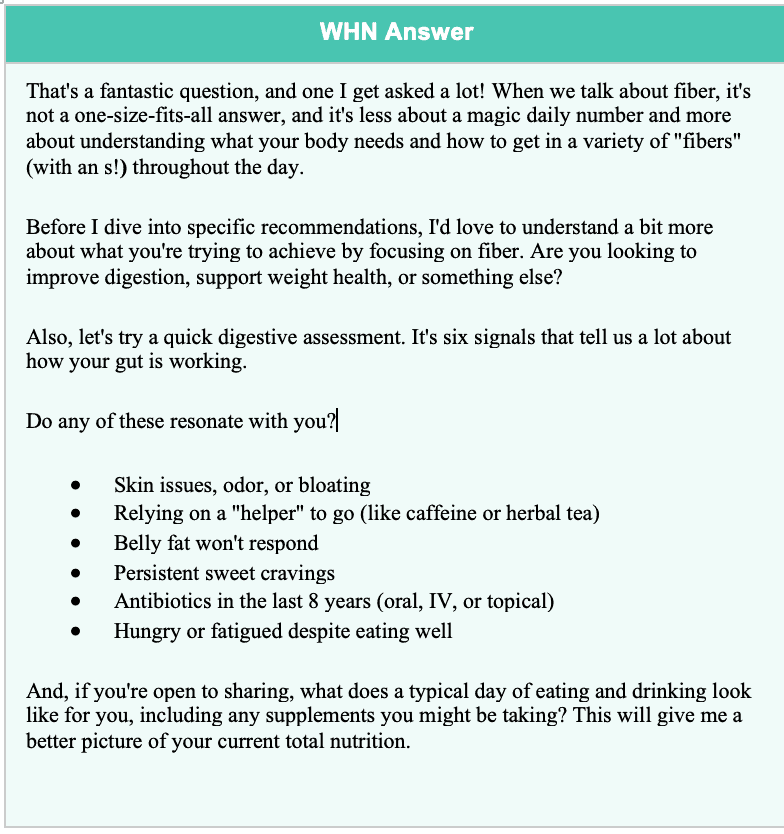
Can AI Create a Personalized Nutrition Plan?
The screenshots above highlight something I find fascinating.
The AI answers are all reasonably good.
They point to similar fiber recommendations, cite many of the same foods, and provide practical advice that’s grounded in widely accepted nutrition guidance.
That’s not surprising. Most AI tools are drawing from much of the same publicly available information and evidence.
The biggest difference isn’t that one AI is “right” and another is “wrong,” it’s that only one will help you figure out what your body needs and how to make those choices more often.
AI Type 1 is at best partially personalized, and that does deliver better weight health outcomes.
They don’t know why you’re asking. They don’t know your digestion, hydration, medications, supplements, lab work, sleep, stress, or health goals. They don’t know what you’ve already tried or what your body is telling you.
The Weight-Health Nutritionist starts somewhere different.
Instead of immediately generating an answer, it gets curious.
When someone asks, “How much fiber do I need?” Ashley Intelligence immediately starts wondering:
- How much fiber are they eating now?
- What are they hoping fiber will help with?
- How is their digestion functioning?
- Would increasing fiber help, or could it actually make symptoms worse?
- What else might be contributing to the problem they’re trying to solve?
That’s where personalization begins.
The value isn’t simply getting a different answer.
It’s asking a better question.
That’s the difference between artificial intelligence and Ashley Intelligence.
One provides information.
The other starts by understanding the person asking for it.
What AI Can and Cannot Do for Your Nutrition Plan
There’s a lot that AI Type 2 can do, but also where it can not help you.
It can help you:
- Generate meal ideas
- Create shopping lists
- Adapt recipes
- Organize information
- Build reminders and routines
- Turn vague goals into actionable steps
- Track habits and even help you run small nutrition experiments
Sometimes what we need isn’t more information — it’s structure and consistency.
Where AI becomes less effective is when it has to figure out why something is happening.
Someone may say they don’t tolerate carbohydrates.
Is that really what’s happening? Or is digestion compromised? Hydration inadequate? Sleep disrupted? Stress elevated? Is medication, hormone status, or meal timing playing a role?
The same thing can happen with lab work.
A lab value may be high or low for many different reasons. Understanding which explanation fits your body often requires looking at patterns over time, not just a single result.
That’s where no AI will work.
You need a qualified weight-health nutritionist to develop your plan.
Once we’ve built a personalized plan together, AI becomes a fantastic tool for helping you implement it.
The goal isn’t to choose between AI and human expertise.
It’s to let each do what it does best.
How to Use AI to Build a Better Nutrition Plan
Your Better Next Step
This is where a truly personalized approach matters.
Working with a team member at BNP, we can help you determine if you have a plan and just need support personalizing it, track observations, identify patterns, generate meal ideas, organize your questions, and remind you when it’s time to bring those questions back to your practitioner. That’s where the Weight Health Nutritionist AI and our community access can help you. Or do you need the qualified human help first to develop your plan, experiments, and reassessment time frames? That’s when the BNP weight health plan is your better next step. Especially if you’ve been trying and not succeeding.
Learning to use AI better will help you be more efficient and effective in your health optimization efforts. AI Type 2 does not replace your healthcare team, but helps us collaborate better, and helps you implement your plan, learn from your own data, and better understand how your body responds over time.
What’s your better next step? Let’s discuss:
Book a free 15-minute consult, and let’s explore how personalized nutrition support and practitioner-guided AI can help you cut through the noise and focus on what works for your body.
About the Author
Ashley Koff, RD, is a registered dietitian with 25 years of clinical experience and one of the country’s leading weight health experts. She is the founder of The Better Nutrition Program and the bestselling author of Your Best Shot. Her work focuses on personalized nutrition, gut microbiome optimization, GLP-1 wellness, and helping individuals achieve lasting weight health through approaches tailored to how their specific body functions.